Choosing an online Quran teacher is one of the most important decisions a family makes. The right teacher can make a child love the Quran for life. The wrong one can make them dread every class. With so many online Quran academies and tutors today, how do you know who to trust?
Here are 7 simple things to check before you choose an online Quran teacher for yourself or your child.
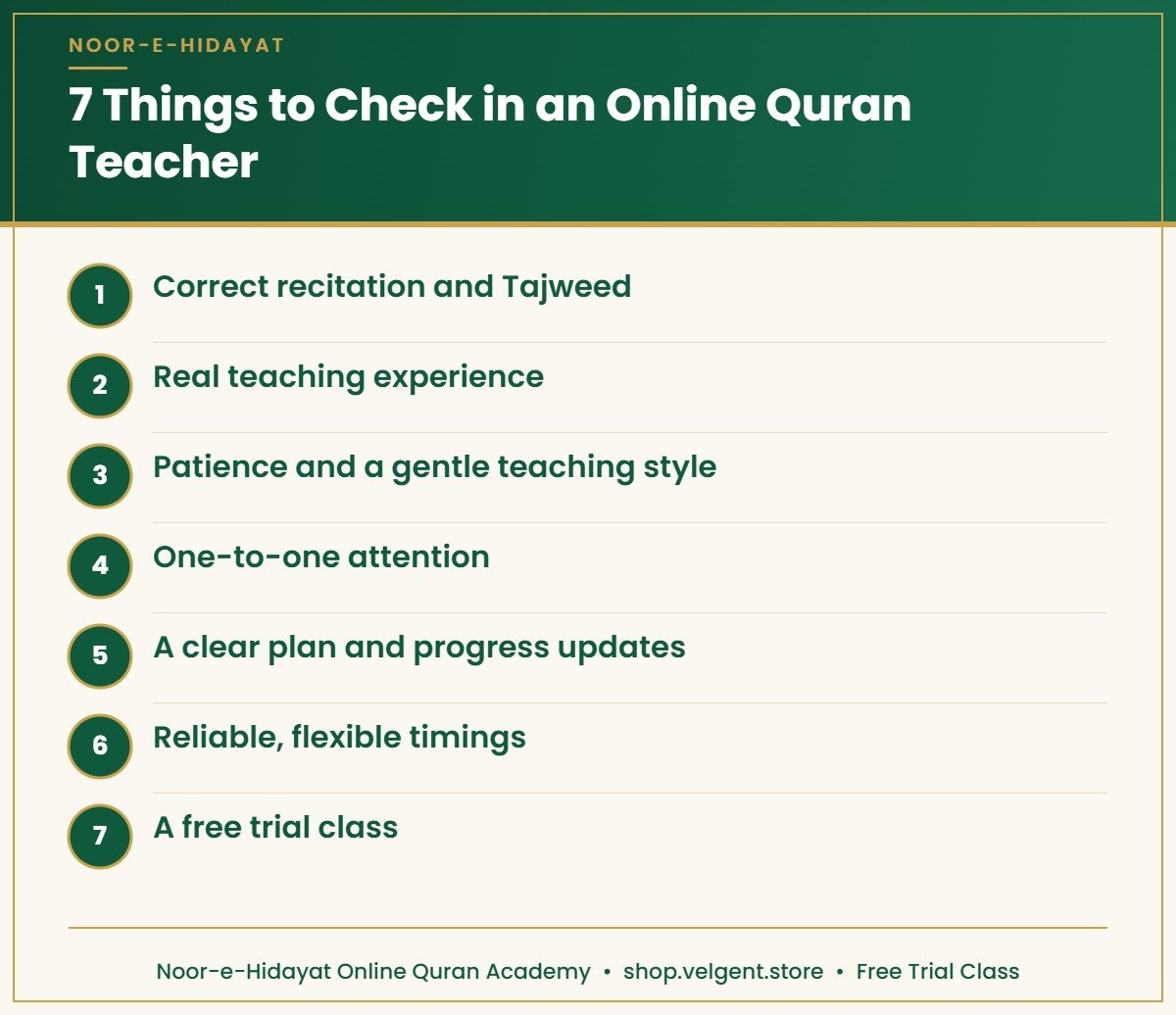
1. Correct Recitation and Tajweed
An online Quran teacher can only teach what they know. Ask the teacher to recite a few ayat during the trial class. Listen for clear letters, smooth flow and correct Tajweed rules. You can compare with expert reciters on Quran.com. If you are not sure what to listen for, our Tajweed for beginners guide covers the basics.
2. Real Teaching Experience
Reading the Quran well and teaching it well are two different skills. Ask how long the teacher has been teaching, which courses they teach (Noorani Qaida, Nazra, Hifz) and whether they have experience with your child’s age group. Teaching a five-year-old needs very different skills from teaching an adult.
3. Patience and a Gentle Teaching Style
This one matters more than most parents realise. A patient online Quran teacher corrects mistakes kindly, repeats without frustration and keeps the class positive. Watch your child’s face during the trial. Do they look relaxed? Do they want to come back? Children learn best from teachers they feel comfortable with.
4. One-to-One Attention
In a one-to-one class, the teacher listens to every word the student reads. In a large group, a shy child can hide for the whole lesson without reading properly. For beginners and young children especially, one-to-one live classes make a big difference to progress.
5. A Clear Plan and Progress Updates
A good teacher follows a clear path. For example, a beginner goes from Noorani Qaida to Nazra with Tajweed, and a Hifz student has a daily plan for new lessons and revision. Ask questions like:
- Where will my child be in three months?
- How do you track progress and revision?
- How will you keep me updated as a parent?
6. Reliable, Flexible Timings
Consistency is the secret of Quran learning. Choose an online Quran teacher who is on time and whose schedule fits your family. Online classes are great here because you can usually choose a time after school, after work or on weekends. If classes are often late or cancelled, progress will suffer.
7. A Free Trial Class
A trustworthy academy will let you try before you commit. A free trial class lets you see the teacher, the teaching style and the technology for yourself. Be careful with anyone who asks for a long upfront payment before you have even met the teacher.
Red Flags When Choosing an Online Quran Teacher
- The teacher lets mistakes slide instead of correcting them.
- The class feels rushed, or the teacher is distracted.
- No clear plan or progress updates.
- Classes are frequently late, short or cancelled.
- Pressure to pay for many months in advance.
A Few More Practical Tips
- Stay nearby at first. For young children, sit close during the first few classes. It helps your child settle and lets you see the teaching style.
- Check the setup. A stable internet connection, a quiet corner and earphones with a microphone make online classes much smoother.
- Ask about teacher preferences. Some families prefer a male or female teacher. Ask the academy what options they have.
- Give it a few weeks. After you choose, give your new online Quran teacher a few weeks to build a connection before judging progress.
For more tips, read our guide on how to start your child’s Quran journey online.
Frequently Asked Questions
Is an online Quran teacher as good as a local teacher?
Yes. An online Quran teacher can be just as good, and sometimes better, because you can choose from more qualified teachers and get one-to-one attention at a time that suits you.
How many classes a week does a child need?
For beginners, short classes of 20 to 30 minutes, four or five days a week, usually work better than one or two long classes.
What should I ask in a trial class?
Ask about the teacher’s experience, how they correct mistakes, what the learning plan looks like and how progress is shared with parents.
Try a Class With Noor-e-Hidayat
At Noor-e-Hidayat, our qualified teachers teach live one-to-one classes with patience and correct Tajweed, 7 days a week from 8 AM to 10 PM. See our online Quran courses or book a free trial class and judge for yourself.
Pingback: Online Quran Classes for Kids: How to Start Without the Stress - Noor-e-Hidayat
Pingback: Best Time for Online Quran Classes Abroad (Pakistan Time Planner) - Noor-e-Hidayat
Pingback: Daily Hifz Routine for Kids: An Easy 4-Step Plan for Home - Noor-e-Hidayat